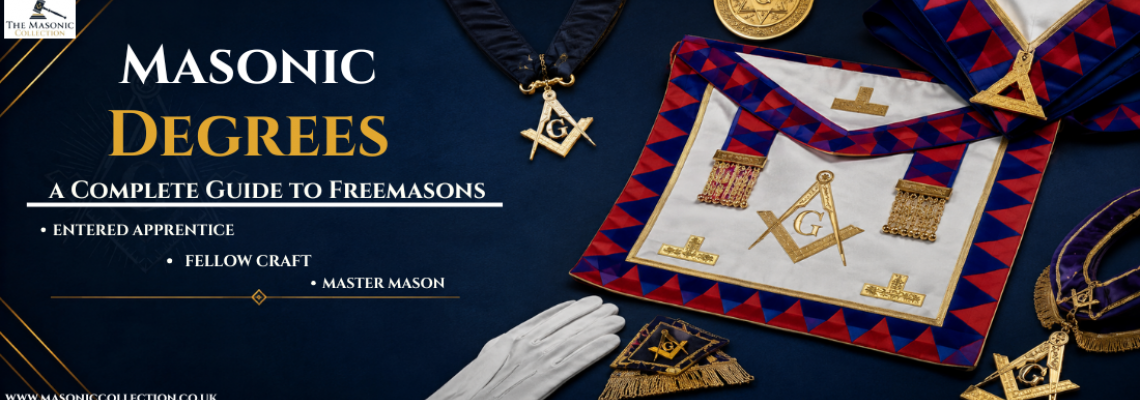
If you’ve ever wondered what the degrees of Freemasonry actually mean, you’re not alone. The word “degree” can make Freemasonry sound like a ladder of ranks, but that’s not really the idea. A Masonic degree is better understood as a stage in a Mason’s journey, with each ceremony bringing its own lessons, symbolism, and opportunities for personal growth.
In English Freemasonry, the journey begins with the Entered Apprentice, continues through the Fellow Craft, and reaches the Master Mason degree. Beyond these three Craft degrees, there are also other Masonic orders and degree systems that members may choose to explore.
So, what happens at each stage, and how do the different Masonic degrees fit together?
What Is a Masonic Degree?
A Masonic degree is a stage in a Freemason’s journey through the Craft. It isn’t simply a title or a way of showing seniority. Each degree has its own ceremony, lessons, and traditions. If you’re new to the subject, it also helps to understand how these stages relate to Masonic regalia, which can reflect a Mason’s degree, role, and wider Masonic involvement.
It’s also worth clearing up a common point of confusion. A degree, a Masonic rank, and a Lodge office aren’t the same thing. A degree marks a stage in the Masonic journey, while an office refers to a role within a Lodge. Rank, meanwhile, can refer to a distinction or recognition within the organisation.
Degree, Rank, Office and Order: What's the Difference?
This distinction becomes especially useful when you start looking at higher degrees of Freemasonry and additional Masonic orders. They aren't simply extra ranks added to one universal ladder. Different Masonic traditions have their own structures and terminology.
How Many Degrees of Freemasonry Are There?
If you search for how many degrees of Freemasonry there are, you’ll quickly find different answers. That’s because Freemasonry isn’t organised around one worldwide system of degrees. The structure can vary between jurisdictions and Masonic rites.
For the United Grand Lodge of England (UGLE), the foundation is the three Craft degrees: Entered Apprentice, Fellow Craft, and Master Mason. UGLE’s Book of Constitutions describes Pure Ancient Masonry as consisting of these three degrees, including the Supreme Order of the Holy Royal Arch.
So, when people talk about the 3 degrees of Masonry, they’re referring to:
First Degree: Entered Apprentice
Second Degree: Fellow Craft
Third Degree: Master Mason
There are also many additional Masonic degrees and orders beyond the Craft. These can include systems such as the Royal Arch, Mark Masonry, Scottish Rite, and York Rite. They shouldn’t simply be treated as one universal ladder where a higher number automatically means a higher rank.
That distinction matters, especially when you come across terms such as the 32nd degree or 33rd degree Mason online. Those numbers belong to particular Masonic systems rather than representing a universal ranking of every Freemason.
The three Craft degrees are where the story begins. Let’s look at what each one actually represents.
The Three Degrees of Freemasonry
The three Craft degrees form the foundation of the Masonic journey in English Freemasonry. Each has its own ceremony and purpose, with the member moving from Entered Apprentice to Fellow Craft and then Master Mason. UGLE describes these ceremonies as stages that encourage members to look after others, improve themselves, and live wisely.
First Degree: Entered Apprentice
The First Degree of Freemasonry marks the beginning of a person's journey. After completing the ceremony of Initiation, the new Mason becomes an Entered Apprentice.
At this stage, the focus is on starting well. The degree introduces ideas around equality, responsibility, and helping those who are less fortunate. It sets the tone for what follows, encouraging a new Mason to think about how their actions affect both themselves and others.
The First Degree isn't about knowing everything straight away. It’s about opening the door to learning.
Second Degree: Fellow Craft
The Fellow Craft degree is the second stage of the Craft journey. After completing the ceremony of Passing, the member becomes a Fellow Craft Freemason.
This degree places greater emphasis on education, learning, and self-development. It encourages a Mason to look beyond the starting point and keep developing their understanding of themselves and the world around them. UGLE describes this stage as encouraging members to better themselves through education and self-development.
That makes the Second Degree a natural progression from the lessons introduced in the First.
Third Degree: Master Mason
The Third Degree of Freemasonry is the stage at which a member becomes a Master Mason. Known as the ceremony of Raising, it marks the completion of the three Craft degrees.
The emphasis here moves towards reflection, responsibility, and making wise use of life. It asks a Mason to think more deeply about the kind of person they want to become and the legacy they leave behind. UGLE describes the Third Degree as teaching members how to use their lives wisely and be remembered for the right reasons.
Reaching Master Mason isn't simply about reaching the next level. It marks the completion of the Craft degree journey and opens the way to further participation in Freemasonry.
Masonic Degree Progression: From Apprentice to Master Mason
The Masonic degree progression follows a clear path through the three Craft degrees. Each stage builds on the one before it, so the journey isn't simply about reaching the next title. There’s a reason for the order, with each degree offering a different perspective on personal growth, responsibility, and Masonic tradition.
Progression also isn't something to rush. A Mason has time between degrees to take part in Lodge life, learn more about the Craft, and reflect on the lessons introduced during each ceremony.
The Freemasonry degree progression therefore works more like a journey of continued learning than a race towards a higher position. Reaching Master Mason completes the three Craft degrees, but it doesn't mean a Mason has reached the end of their involvement in Freemasonry. There are other Masonic orders and degree systems that members may choose to explore depending on their interests and the traditions of their jurisdiction.
What Other Masonic Degrees and Orders Are There?
The three Craft degrees form the foundation of Freemasonry, but the wider Masonic world includes many other degrees, orders, and traditions. Which ones a Mason encounters depends on their jurisdiction, interests, and the Masonic bodies they join.
Some of the main Masonic traditions represented by The Masonic Collection include:
Royal Arch

The Royal Arch Masonic has a particularly important place in English Freemasonry and is closely connected with the three Craft degrees. In the English system, UGLE describes the Royal Arch as completing the journey of Pure Ancient Masonry.
Mark Master Mason and Mark Masonry

Mark Masonry is another part of the wider Masonic landscape, with the Mark Master Mason degree having its own traditions and ceremonial requirements.
Royal Ark Mariner

The Royal Ark Mariner is another Masonic order associated with the wider Mark tradition. It has its own ceremonial structure and regalia.
Royal & Select Masters

The Royal and Select Masters are associated with the Cryptic tradition and include degrees such as Royal Master, Select Master, and Super Excellent Master.
Rose Croix

Rose Croix is associated with the 18th Degree within Scottish Rite systems. It is one of the best-known higher-degree traditions and is often searched for alongside terms such as 18th Degree, Masonic Rose Croix, and Scottish Rite degrees.
Knights Templar

Knights Templar is another distinct Masonic order with its own ceremonial traditions and regalia. If you're researching this part of the wider Masonic journey, The Masonic Collection has a dedicated Knights Templar regalia section.
Knights Malta

The Knights Malta tradition is also represented within The Masonic Collection's range of Masonic regalia and belongs in the wider discussion of Masonic orders rather than being presented as one of the three Craft degrees.
Red Cross of Constantine

The Red Cross of Constantine is a Masonic and military order with its own degree structure. Its ceremonies include the Knight, Priest-Mason and Prince-Mason degrees, alongside the appendant Orders of the Holy Sepulchre and St John the Evangelist.
Allied Masonic Degrees

The Allied Masonic Degrees bring together a number of additional Masonic degrees and traditions. They are another example of why there isn't one universal ladder of Masonic degrees followed by every Freemason.
Order of Athelstan

The Masonic Order of Athelstan is a distinct Masonic order based around the history and legend of King Athelstan, with a focus on Masonic history, symbolism, education and fellowship.
Royal Order of Scotland

The Royal Order of Scotland is one of the historic orders within Freemasonry and has its headquarters in Edinburgh. The Order has its own two-degree structure and admits members from within Freemasonry by invitation.
Order of the Secret Monitor

Your website's OSM Regalia category should also be represented. Here, I would use the full name Order of the Secret Monitor (OSM) rather than simply writing “OSM”, so readers understand what the abbreviation means.
Saint Thomas of Acon

The Order of Saint Thomas of Acon is another Masonic-related tradition represented by your website. It has its own history and organisation and should be treated as a separate order rather than being described as one of the three Craft degrees. The St Thomas of Acon Lodge in London, for example, is a Masonic Lodge named after St Thomas of Acon.
Scottish Rite Degrees: 18th, 32nd and 33rd Degree Explained
When people search for Scottish Rite degrees, they often come across numbers such as the 18th Degree, 32nd Degree, and 33rd Degree Mason. These numbers can make Scottish Rite Freemasonry look like one long ladder of Masonic ranks, but that’s not quite how it works.
The Scottish Rite builds on the first three Craft degrees and, in the Northern Masonic Jurisdiction, includes 29 degrees numbered from the 4th through the 32nd. These are organised into four bodies.
The 18th Degree is particularly well known because it belongs to the Chapter of Rose Croix. The degree is associated with themes of tolerance, faith, and universal principles.
The 32nd Degree is the final numbered degree in this Scottish Rite system. It explores themes including the choice between self-interest and service to humanity.
Then there’s the 33rd Degree Freemason. Despite what you might see online, the 33rd Degree isn't a universal “highest degree” of Freemasonry. Within the Scottish Rite, Northern Masonic Jurisdiction, it’s an honorary distinction conferred by the Supreme Council in recognition of outstanding service.
So, if you see terms such as 33 degree Freemason, 33d degree mason, or Masonic higher degrees, it’s worth checking which Masonic rite or jurisdiction the person is referring to. The numbers don't represent one worldwide ranking system.
33rd Degree Freemason Symbols and Meanings
The 33rd Degree Freemason symbols and meanings are closely connected with the Scottish Rite's traditions and its emphasis on service, honour and responsibility. One of the best-known symbols associated with the 33rd Degree is the double-headed eagle, which is used as an emblem of the Supreme Council in some Scottish Rite jurisdictions. The official Scottish Rite, Southern Jurisdiction, identifies the double-headed eagle with the 33° Supreme Council.
Other imagery associated with Scottish Rite symbolism can include the square and compasses, the sword and scales, and the motto “Ordo Ab Chao”, which appears in historical descriptions of the 33° jewel.
The symbolism shouldn't be treated as a universal code shared identically by every Masonic jurisdiction. Designs, interpretations, and ceremonial traditions can vary. The 33rd Degree itself is also a distinction within Scottish Rite rather than a universal highest degree of all Freemasonry.
York Rite Degrees and Other Masonic Orders
The York Rite degrees are another example of why there isn't one single ladder of Masonic degrees. The York Rite brings together several Masonic bodies, each with its own ceremonies and traditions, rather than simply adding numbers to the three Craft degrees.
Royal Arch Chapter
Within the York Rite structure, the Chapter includes degrees such as:
Mark Master
Past Master
Most Excellent Master
Royal Arch
The Mason Royal Arch degree is particularly well known and explores themes that continue the Masonic journey beyond the Craft degrees.
Cryptic Council
The next part of the York Rite is the Council of Royal and Select Masters. Its degrees include:
Royal Master
Select Master
Super Excellent Master
These are often grouped under the term Royal and Select Masters.
Knights Templar
The York Rite also includes the Knights Templar, with its own distinctive ceremonial traditions and historical themes. You'll sometimes see references to Knights Templar, knights and templars, or Knights Templar Knight when researching this area of Freemasonry.
The wider Masonic landscape can also include bodies such as the Allied Masonic Degrees and Royal Ark Mariner. However, availability and organisation vary between countries and jurisdictions, so they shouldn't be presented as compulsory stages for every Freemason.
The key takeaway is simple: Masonic orders and degrees don't form one universal worldwide progression. The three Craft degrees provide the foundation, while different Masonic traditions offer their own paths beyond them.
What Do Masonic Degrees Teach?
The degrees of Freemasonry aren't simply about progressing from one stage to another. Each degree introduces ideas that encourage a Mason to think about how they live, treat others,s and contribute to their community.
The lessons vary between Masonic traditions, but some themes appear again and again:
Personal improvement: becoming more thoughtful and responsible.
Learning: developing knowledge and keeping an open mind.
Service: helping others and contributing where possible.
Integrity: acting honestly and keeping to strong principles.
Reflection: taking time to consider your choices and their consequences.
Brotherhood: building friendships and supporting fellow members.
UGLE describes the three Craft ceremonies as stages of personal development, with the First Degree focusing on helping others, the Second on education and self-development, and the Third on using life wisely.
This is where Masonic symbolism, ritual, and ceremony become meaningful. Rather than simply being formal traditions, they provide a framework through which these ideas are explored.
And that's really the point of the journey. A degree isn't valuable just because you've completed it. What matters is what you take from it.
Masonic Degrees and Custom Regalia
As a Mason progresses through different degrees, orders, or offices, their ceremonial requirements may change. The right regalia can depend on the Lodge, Masonic order, office, and local requirements, so it’s worth checking what you actually need before placing an order.
For Lodges or members looking for something beyond standard designs, custom Masonic regalia can be a practical option. Custom pieces can be made with specific colours, embroidery, badges,s or other details to suit a Lodge or Masonic body's requirements.
If you're looking for personalized pieces, explore our custom Masonic regalia collection and see what options are available.
There’s no need to guess. Check your requirements first, then choose the regalia that fits your Masonic role and occasion.
Masonic ceremonial traditions have developed over many years, and the regalia used today reflects part of that history. If you’re interested in how Masonic regalia developed from earlier traditions into the ceremonial dress seen today, take a look at our guide to The History of Masonic Regalia.
Check the Latest Masonic Promotions
If you’re preparing for the next stage of your Masonic journey, it’s worth checking the latest Masonic promotions before you order. The Masonic Collection regularly features selected regalia, accessories and package offers, giving you a chance to find what you need at a better price.
Explore our Masonic promotions to see the latest offers and featured products.
A quick look before you buy could save you a few pounds.
Stay Updated With The Masonic Collection
Want to keep up with new Masonic products, useful guides and the latest Masonic promotions? Subscribe to The Masonic Collection newsletter and stay in the loop with new arrivals, selected offers and helpful Masonic content.
You can also hear about special offers before they pass you by.
Subscribe to the Masonic Collection newsletter and keep up with what’s new.
Need Help With Your Masonic Requirements?
Choosing the right Masonic items can sometimes be confusing, especially when requirements differ between degrees, offices, and Masonic orders. If you’re unsure what you need, it’s always best to check your Lodge or relevant Masonic body's requirements first.
If you need help finding the right product or have a specific custom Masonic regalia requirement, The Masonic Collection team can help you explore the available options.
Have a question? Get in touch with The Masonic Collection before placing your order.
Understanding the Degrees of Freemasonry
The degrees of Freemasonry are best seen as a journey rather than a race to collect titles or numbers. The three Craft degrees, from Entered Apprentice through Fellow Craft to Master Mason, provide the foundation, with each stage bringing its own lessons and opportunities for reflection.
Beyond the Craft, there are other Masonic orders and degree systems, including the Royal Arch, Mark Masonry, Scottish Rite, and York Rite. Their structures can differ depending on the Masonic tradition and jurisdiction, so there isn't one universal path that every Freemason follows.
What makes the journey worthwhile isn't simply reaching another degree. It's the learning, friendships, service, and personal development that come with taking part in the Craft.
If you're exploring your own Masonic journey or looking for suitable regalia along the way, The Masonic Collection can help you find the right options for your requirements.
Frequently Asked Questions About Masonic Degrees
What are the degrees of Freemasonry?
The degrees of Freemasonry are stages within a Mason's journey. In English Craft Freemasonry, the three principal degrees are Entered Apprentice, Fellow Craft,t and Master Mason.
How many Masonic degrees are there?
There isn't one universal number. The three Craft degrees form the foundation, while other Masonic orders and rites have their own additional degrees and structures.
What are the 3 degrees of Masonry?
The three Craft degrees are First Degree: Entered Apprentice, Second Degree: Fellow Craft, and Third Degree: Master Mason.
What is the First Degree of Freemasonry?
The First Degree is the Entered Apprentice degree and marks the beginning of a Mason's journey through Craft Freemasonry. It introduces the new Mason to the principles and traditions of the Craft.
What is the Master Mason degree?
The Master Mason degree is the Third Degree of Freemasonry and completes the three Craft degrees. It focuses on themes of reflection, responsibility, and living wisely.
Is the 33rd degree the highest degree in Freemasonry?
Not universally. The 33rd Degree is an honorary distinction within the Scottish Rite system in the jurisdiction discussed earlier. It isn't a universal highest rank across all Freemasonry.
What is the Royal Arch degree?
The Royal Arch has a distinctive place in English Freemasonry and is closely connected with the three Craft degrees. It shouldn't simply be treated as a universally recognised "fourth degree" across all Masonic traditions.
Are Masonic degrees the same as Masonic ranks?
No. A degree represents a stage within a Masonic system, while a rank can refer to a distinction or recognition. A Lodge office is different again, as it describes a role held within a Masonic body.
Related Products